Bali 5.2: A New Standard in Catamaran Cruising
The Bali 5.2 marks a significant step forward, blending autonomy, spaciousness, and user-friendliness into a design suitable for both private owners and charter fleets. Our test sail off Toulon aboard the prototype “OLIVIER,” named in honor of Bali’s founder Olivier Poncin, revealed a catamaran poised to redefine the cruising experience. This model aims to surpass its predecessors by offering enhanced self-sufficiency, increased living space, and versatility to satisfy discerning owners and charter operators alike.
Spacious Living Transformed by Bali’s Design
Stepping aboard, the overwhelming sense of space is immediately apparent. Bali’s signature tilting aft door seamlessly connects the cockpit and saloon, creating an open-plan feel rarely found in this size range. With the saloon closed, it transforms into a comfortable, climate-controlled interior space. Open, it becomes a vast outdoor lounge, perfect for relaxing at anchor or while sailing. The layout promotes easy movement, free of steps or obstacles, and benefits from mature ergonomics. The forward door, another hallmark of Bali, further enhances this flow, providing easy access to the foredeck and exceptional cross-ventilation when combined with the aft openings – a feature appealing to both families and charter companies.
“The Bali 5.2 doesn’t chase raw performance, but rather comfortable, quiet, and easy-to-handle cruising.”
Multiple Relaxation Zones from Bow to Flybridge
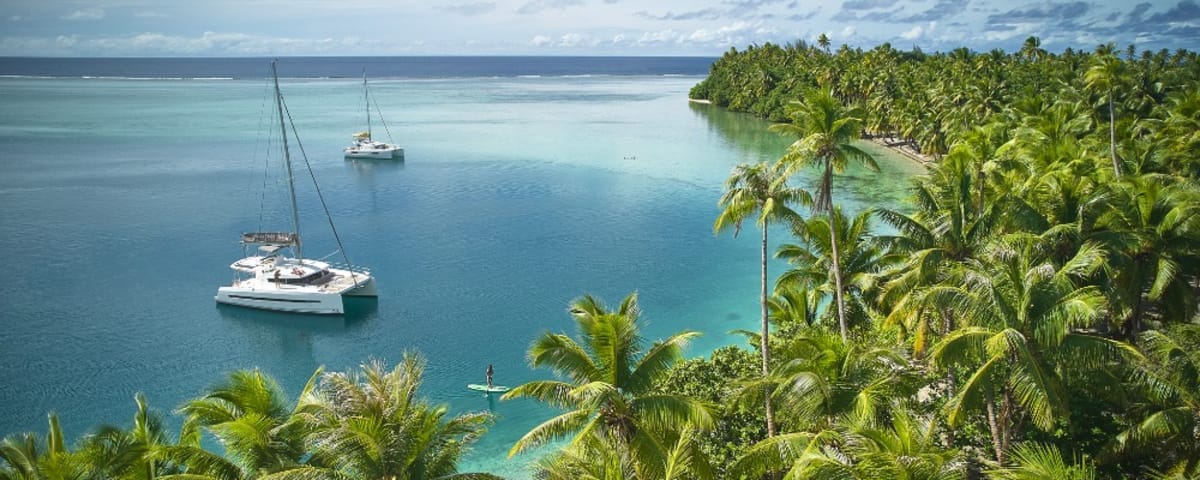
The expansive sunbathing area on the foredeck is impressive. It can be shaded with a canvas awning at anchor, transforming into an additional dining space, well-ventilated and isolated from noise. The flybridge features another large sunbed, ample seating, a deep relaxation area, and a slightly offset helm station, allowing for easy maneuvering without disturbing passengers. The overall impression is of a volume far exceeding what the overall length suggests.
Smooth and Silent Sailing
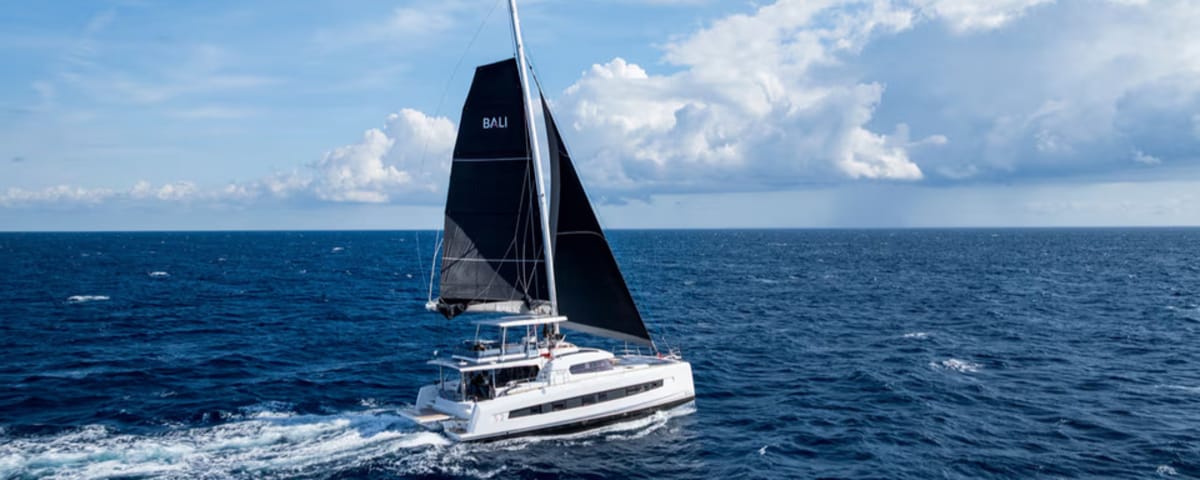
Leaving Toulon, we hoisted the sails. The square-top mainsail, black for this test, rose quickly with the electric winches, followed by the genoa. Two configurations are available: a self-tacking jib for charter fleets, simplifying handling for less experienced crews, or an overlapping genoa, more powerful and refined, for private owners. Under mainsail and genoa, the 5.2 cruised at around 7 knots in a moderate breeze. The boat remained stable, quiet, and predictable, without any harshness. With the Code 0 unfurled, the speed increased to between 8.5 and 9 knots, effortlessly. The platform remained solid, with no parasitic noise or vibration, staying true to the Bali philosophy of smooth, balanced cruising. An asymmetrical spinnaker is offered, but was not installed on this unit.
Thoughtful Interior Layouts for Life Onboard
Inside, the influence of designer Piatton Studio is immediately evident. The port hull features an owner’s suite, complete with a large sleeping area, separate dressing room, spacious bathroom, independent toilet, and ample storage. The ambiance is modern and bright, and the feeling of space surpasses the standard for 52-foot catamarans. This configuration is designed for extended stays, perfectly suited for an owner planning to live aboard for several months.
The starboard hull, in contrast, was presented in a three-cabin version: two accessible from the interior, and a third independent cabin, accessible from the exterior, equipped with bunk beds. This isolated cabin is ideal for a charter skipper, a teenager, or a guest seeking more privacy – a versatile configuration highly valued by operators.
The central galley is a major asset. Positioned in the middle of the deck plan, it offers excellent visibility forward and aft. The equipment is comprehensive, worthy of a villa: large work surfaces, generous storage, ample refrigeration, and modern cooking appliances (gas or induction, depending on the options chosen). The opening windows to the cockpit, combined with the large aft bulkhead, create a vast saloon-galley-cockpit space. With the forward door open, the natural ventilation is remarkable, making this catamaran particularly pleasant to live on at anchor.
48V Autonomy: A Game Changer at Anchor
The 48V energy system is one of the most significant innovations of the 5.2. The boat carries 4,200 W of solar panels, installed not only on the flybridge roof but also around the entire flybridge, maximizing the available surface area. In addition, there are two 8 kW alternators, fully integrated into the lithium system. The boat operates without a generator, radically changing the experience at anchor: silence, autonomy, simplicity. For an owner, this guarantees long stays at anchor without noise or constraints. For a charter fleet, it means less maintenance, fewer immobilizations, and fewer breakdowns – a major advantage.
Designed for Two Worlds: Owners and Charter
The shipyard confirms that the first owner of the 5.2 is an American who will use it for a world tour. His priorities were simple: autonomy, silence, volume, and ease of use. On the other hand, the first charter orders show the interest of the bases for the independent cabin, the intuitive interior/exterior circulation, the central galley for groups, and the general ease of operation (self-tacking jib, electric winches, simple electronics).
Minor Adjustments Needed
The prototype had undersized Code 0 hardware, already corrected on subsequent units according to the shipyard. The first step of the descent to the engine room is a little low, a detail that owners will notice, but which will likely disappear in the production versions. Nothing significant, but points noted for a transparent review.
A Coherent Catamaran for Modern Cruising
The Bali 5.2 ultimately proves to be very coherent. It does not seek raw performance, but rather comfortable, quiet, and easy-to-handle cruising. Its volumes, natural ventilation, central galley, autonomy, and layouts make it a modern cruising catamaran, designed for life onboard as much as for intensive use.
The Good
- Very beautiful interior and exterior volumes
- Possibility of several cabin configurations (owner/charter)
- Front door + hydraulic rear bulkhead: space totally open or closed as needed
- Serious 48 V autonomy (solar panels + alternators)
The Not-So-Good
- Undersized Code 0 hardware on the prototype (corrected by the shipyard)
- First step of the machine descent a little low
- Correct performance but clearly “cruising” orientation
Specifications
- Length at waterline 15.32 m
- Overall length 16.41 m
- Usable area 115.4 m2
- Standard sail area 146 m2
- Maximum upwind sail area 199 m2
- Design Aurélien PONCIN
- Manufacturer CATANA Shipyard
- Naval architect Xavier Faÿ
- Interior architect Agence Berco design + Piaton
- Maximum loaded displacement 16.4 t
- CE Category A: 14 / B: 16 / C: 24 / D: 40 people
Price of the tested boat: 1,250,000 euros excluding VAT
Enjoyed this post by Thibault Helle? Subscribe for more insights and updates straight from the source.