PeptiSystems’ Technology Validated in New Peptide Synthesis Study
PeptiSystems, a life science company specializing in advanced manufacturing solutions for peptide and oligonucleotide drugs, has announced that its PeptiPilot® instrument played a crucial role in a recent scientific study from the University of Zurich. The study explored scalable methods for peptide synthesis, highlighting the potential of PeptiSystems’ flow-based technology to address a major challenge in peptide production: aggregation.
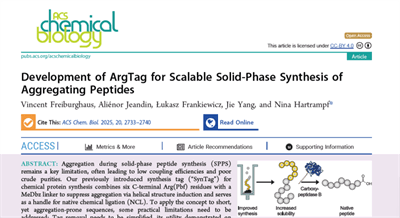
Aggregation, the clumping together of peptide molecules during synthesis, can significantly hinder product quality and yield. The University of Zurich researchers sought to refine a method, known as ArgTag, to mitigate this issue during solid-phase peptide synthesis (SPPS).
Key Findings and Implications
The research team evaluated the ArgTag method across six different solid supports and various synthesis scales. Consistently, they observed reduced aggregation and improved product quality under all tested conditions. Importantly, further testing with the PeptiPilot® system demonstrated reproducible results under conditions relevant to larger-scale manufacturing, confirming the method’s scalability.
“We are pleased that PeptiPilot® was chosen as the synthesis system for this research at the University of Zurich,” said Karin Granath, CEO of PeptiSystems. “Aggregation has long been an obstacle in peptide production, and this study shows how our flow-based technology can help manage the challenge. By bridging the gap between lab research and industrial peptide manufacturing, PeptiPilot® creates a faster and more sustainable path to next-generation drugs.”
The ArgTag Method: A Promising Solution
Professor Nina Hartrampf from the University of Zurich, stated, “Our goal was to develop a practical method to improve the synthesis of difficult peptides. It was positive to see that ArgTag, which we have developed on our AFPS platform, performed equally well in the PeptiPilot® system under process-relevant conditions.”
Vincent Freiburghaus, the lead researcher and principal author of the study, added, “Through the collaboration with PeptiSystems, we were able to evaluate the method’s robustness under realistic synthesis conditions. PeptiPilot® delivered consistent results and proved well-suited for scaling up the method from lab scale to larger scale.”
Study Details
The study, titled “Development of ArgTag for Scalable Solid-Phase Synthesis of Aggregating Peptides,” was conducted by Professor Nina Hartrampf’s research group at the Department of Chemistry, University of Zurich, with contributions from Łukasz Frankiewicz and Jie Yang at PeptiSystems AB. The publication is available as open access in the peer-reviewed journal ACS Chemical Biology.
About PeptiSystems AB
PeptiSystems is a life science company developing next-generation flow-based instruments for the synthesis of peptide and oligonucleotide drugs. With its patented technology, PeptiSystems’ instruments significantly reduce production times, improve synthesis control, and minimize raw material consumption – without compromising purity or yield. Thanks to its scalability, the company’s innovative synthesis instrument can be easily adapted from small-scale development to large-scale production, enabling pharmaceutical companies and CDMOs to meet the growing global demand for high-performance, cost-effective, and sustainable manufacturing processes. PeptiSystems is headquartered in Uppsala, Sweden.
Enjoyed this post by Thibault Helle? Subscribe for more insights and updates straight from the source.