Maintaining Fresh Water on Your Boat: A Comprehensive Guide
Access to fresh water is crucial for any boating trip, whether it’s a short day trip or an extended cruise. Ensuring you have a reliable and safe water supply requires careful planning and maintenance. This guide provides insights into water storage, distribution, and treatment to help you maintain a healthy water system on board.
Water Storage Solutions
Most cruising boats come equipped with rigid water tanks made of stainless steel, alloy, or plastic. However, these tanks often lack the capacity for multi-day voyages without needing to replenish supplies at a port. If space permits, consider adding extra tanks. You can choose between flexible and rigid models, depending on your boat’s configuration.
Flexible tanks are easier to install and come in various shapes and sizes, including triangular options for the bow. However, on boats without molded interiors, protect the tank fabric from chafing with a protective layer underneath. Rigid tanks are an ideal solution, but their installation is more complex. Both flexible and rigid tanks can be custom-made to fit your specific needs.
Pressurized Water Systems
While foot pumps are rare on standard production boats, pressurized water distribution systems using electric pumps are common. These are convenient but rely on the pump’s functionality and electrical power. For long cruises, it’s wise to supplement electric pumps with manual pumps, which also conserve water. Electric pumps come in two main types: diaphragm and turbine.
Diaphragm pumps use an electric motor to move a diaphragm via a connecting rod or toothed belt. The diaphragm’s movement draws water in one direction and expels it in another. Turbine pumps use a motor to spin a turbine that draws water. Both types of pumps designed for water distribution are self-priming and can run dry briefly while filling the system. A pressure switch and electrical contactor control the pump’s operation. The pressure switch starts the pump and monitors the pressure in the pipes, ensuring it matches the set level.
Minimizing Pump Noise
Water pumps can be noisy and activate automatically when a faucet is opened or even when there’s a leak, even a small drip. To prevent frequent activation, some systems include a pressure accumulator tank (hydrophore). This tank, which can hold several gallons, stores water under pressure, providing a reserve that can supply up to 80% of its capacity. The pump only activates when the tank is about three-quarters empty, running until it’s full again.
Hot Water Comfort
Most propulsion engines above 20 horsepower use indirect cooling systems. This system can heat water in a water heater by circulating engine coolant through a coil inside the tank. When the engine is running at operating temperature (85°C to 95°C), the water in the heater can reach 60°C in under 30 minutes. The efficiency depends on the heater’s insulation and the coil’s surface area. Most water heaters also have a 230-volt electric heating element that can be powered by a generator or shore power.
Preventing Water Contamination
Water tanks are susceptible to contamination from seawater, algae, limescale, and sand, which can cause illness if consumed. High temperatures can also promote bacterial growth. Contaminated water may have an unpleasant odor or taste, but it can also be contaminated without any noticeable signs. To minimize these risks, take the following precautions:
- Clean the tanks, especially when recommissioning the boat.
- Empty the tanks and water system at least three to four times a year.
- Ensure the water filler caps are tightly closed when washing the deck.
- When filling from a dockside source, flush the hose before connecting it to the filler.
- For winter storage, drain and rinse the tanks thoroughly. Use a product to prevent bacterial growth.
- If leaving water in the tanks during winter, add a product like Bactend to prevent bacterial growth.
- When recommissioning, rinse the tanks by filling and emptying them. Add a treatment product.
Cleaning and Treatment Products
Various products are available for cleaning tanks and treating water. Always choose products safe for contact with food. For effective tank cleaning and deposit removal, use specialized cleaners like T.S.4 (Matt Chem). This product eliminates sludge from the tank bottom. First, completely drain the tank, then add one part T.S.4 to three to five parts water. Let it sit for an hour. If the tank has an access hatch, scrub the walls. Next, add 20 liters of water and drain, opening all faucets. Finish by rinsing the tank with clean water. Refill with water and one liter of KILBACTE, then repeat the drain and refill. Finally, add a treatment like KILBACTE at 25 ml per 100 liters of water. Marine suppliers offer chlorine-free treatment and preservation products to prevent bacteria, such as Yachticon’s Aqua Clean, Katadyn’s Micropur, and Pura Tank for cleaning. Always read the instructions and ensure the product is compatible with food-grade applications.
Onboard Water Purification
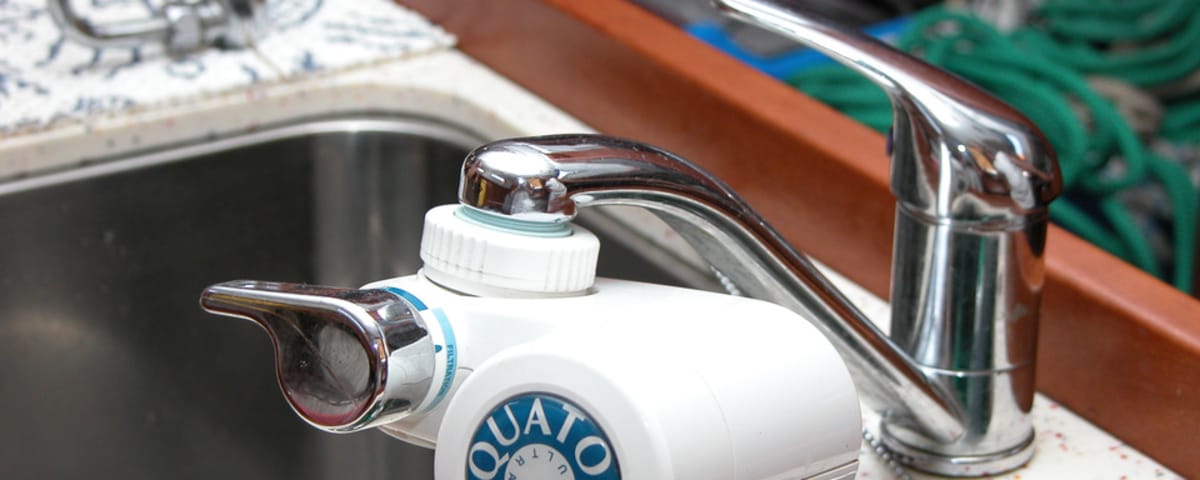
For advanced water treatment, consider a water purification system. These systems treat water without producing it. These systems use reverse osmosis, including pre- and post-treatment with bacteriological action, to produce purified water instantly. It includes a faucet with a maintenance alarm for filter changes. Its compact size allows for easy placement on the boat. The unit can be mounted vertically or horizontally. Once positioned, connect it to the boat’s water distribution system (pressure between 1.5 and 6 bars) and to a dedicated faucet. To prevent contamination, use a two-way faucet at the sink: one for tank water and one for treated water, with separate lines. It can produce 2 liters of purified water every 10 minutes using two parallel membranes.
Key Takeaways
Water is essential on board, so plan for at least 1 to 2 liters per person per day for drinking. Unless you use bottled water, which is inconvenient and bulky, store water in tanks. Keep these tanks clean and treat the water to prevent bacterial growth. Maintain the cleanliness of the tanks and the entire distribution system, including the filler hose.
Enjoyed this post by Thibault Helle? Subscribe for more insights and updates straight from the source.