The True Cost of Electric vs. Diesel for Pleasure Boats: An In-Depth Analysis
When considering the switch to electric for your boat, it’s easy to get caught up in the allure of “green” technology and potential fuel savings. However, a closer look reveals a more complex picture, where the initial cost and long-term maintenance can significantly impact your wallet. Is electric propulsion truly the economical choice for the average boater?
Beyond Fuel: Unveiling the Hidden Costs
Many boat owners are surprised to learn that fuel isn’t always the biggest expense. Docking fees, insurance, maintenance, handling, winter storage, and unexpected repairs often outweigh fuel costs, especially for recreational boaters. While the price of diesel fuel and electricity fluctuates, the key lies in understanding how much you actually use your engine.
Currently, diesel fuel averages around €1.69 per liter in France, while electricity hovers around €0.2175 per kWh in the EU. While electricity appears cheaper, the relatively low engine usage of many pleasure boats, particularly sailboats, can negate this advantage.
The Elephant in the Room: Acquisition and Replacement Costs
The most significant hurdle for electric propulsion is the initial investment. Comparing a new 10-12 meter sailboat or a motor refit reveals a stark difference:
- Diesel: A 30 hp inboard diesel engine costs roughly €10,000 to €15,000 installed. This mature technology benefits from mass production, keeping prices stable.
- Electric: An equivalent electric motor with decent range (thanks to lithium LiFePO4 batteries) can easily cost between €25,000 and €45,000.
This price gap requires a substantial amount of fuel savings to justify the initial investment.
A Realistic Scenario: Crunching the Numbers
Let’s consider a typical cruising sailboat of 10-12 meters used for recreational purposes, not professional sailing.
Assumptions:
- 80 hours of engine use per season.
- Diesel consumption: 6 liters per hour.
- Electric consumption: 15 kWh per hour.
- Docking fees, insurance, and minor expenses are consistent across both options.
Based on these figures:
- Diesel fuel cost: 80 hours x 6 liters/hour x €1.69/liter = €811.
- Electric energy cost: 80 hours x 15 kWh/hour x €0.2175/kWh = €261.
- Approximate fuel savings with electric: €550 per season.
This illustrates that the substantial upfront cost of an electric system, driven by the battery pack, cannot be quickly offset by energy savings alone. The true comparison lies elsewhere.
The Real Cost Drivers: Immobilization and Batteries
Electric propulsion significantly alters two key aspects:
First, routine maintenance on the propulsion system. A well-installed electric system can reduce the frequency of oil changes, filter replacements, and certain mechanical failures. However, it doesn’t eliminate all maintenance, including issues with the saildrive, propeller, shaft, sealing, corrosion, or power electronics.
Second, the inevitable battery replacement. How many seasons will pass before a significant investment is required to replace the battery pack? While battery prices for electric cars have decreased, the marine environment presents unique challenges: shocks, humidity, ventilation, irregular cycles, long periods of inactivity, and temperature variations. Replacing a marine battery pack involves immobilization, diagnostics, safety measures, and testing.
Consider a boat with a 60 kWh battery pack (a reasonable size for decent range). Replacing the pack after 8 seasons, even at the theoretical automotive market price of $100/kWh, could cost $6,000 (€5,100) before installation, labor, logistics, and markups.
This highlights the core trade-off: electric propulsion may be cheaper per hour of use, but more expensive in terms of initial investment and battery replacements.
Docking and Insurance: No Miracles Here
The notion that a “greener” boat automatically translates to lower docking and insurance costs is a misconception. Docking fees primarily depend on the boat’s length, location, season, and local demand. Electric propulsion doesn’t shorten the boat. However, electric boats may receive priority on waiting lists in some French ports, which can be a significant advantage.
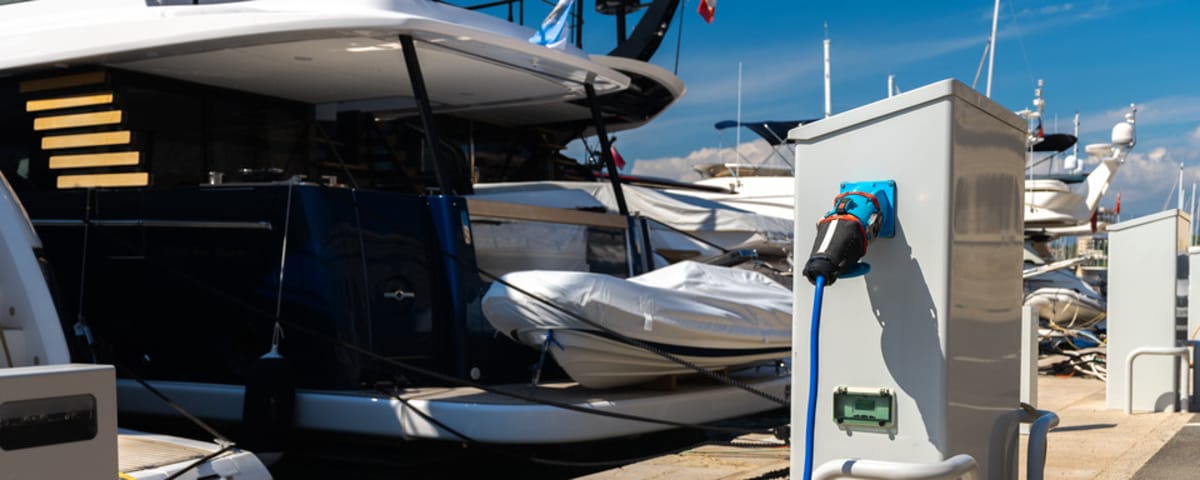
While Europe is pushing for shore power electrification for ships, many ports are lagging behind. This impacts pleasure boaters as well: reliable and fast charging remains inconsistent, creating economic uncertainty due to potential delays and added costs.
The Overlooked Cost: Weather and Autonomy
With electric propulsion, you’re not simply “filling up.” You’re managing a limited energy reserve, which is quickly depleted by rough seas, headwinds, opposing currents, a dirty hull, or the desire for higher speeds. The energy consumption can spike due to unforeseen conditions.
Electric or Diesel: Who Wins on “True Cost”?
There’s no single answer, as the “true cost” varies depending on the boater’s profile:
The Primarily Dockside Boater
Annual expenses are dominated by docking fees, insurance, and boat maintenance. Electric propulsion may not be economically advantageous in this case, as energy savings are limited. The choice may be driven by comfort, silence, or access to certain areas, rather than cost savings.
The High-Engine-Hour Boater
Electric propulsion starts to offer economic benefits in terms of energy and certain maintenance aspects. However, a comprehensive calculation, including battery replacements, is crucial, and the higher purchase price must be considered. Increased cycling enhances energy savings but also accelerates battery degradation.
The Professional or Semi-Professional Boater
This is the only scenario where electric propulsion can become a rational management decision: high engine hours, careful planning, optimized charging, and minimized downtime. This contrasts sharply with the often-unplanned nature of recreational boating.
The Most Important Questions Before Buying
Diesel is a mature, well-understood technology with readily available repairs and easy fuel storage. Electric propulsion is rapidly advancing, with decreasing battery prices and a developing ecosystem. However, the true cost in pleasure boating hinges on three key questions:
- How many actual engine hours per season, and under what conditions?
- What is the real accessibility and cost of charging in your boating area, considering the uneven development of port infrastructure?
- What is your 5-10 year strategy for energy storage, including the inevitable battery replacement investment?
Enjoyed this post by Thibault Helle? Subscribe for more insights and updates straight from the source.