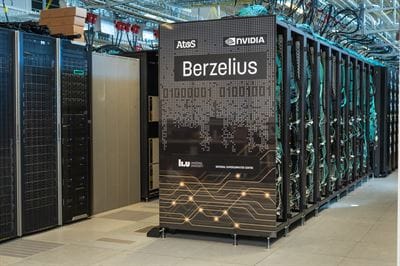
Supercomputer Berzelius at Linköping University Doubles Capacity
The latest upgrade to the Berzelius supercomputer at Linköping University is complete. With doubled capacity, researchers across Sweden can tackle current and future challenges in fields such as materials science, bioinformatics, and machine learning.
Matts Karlsson, Vice-Chancellor for Research at Linköping University (LiU), stated, “The expansion of Berzelius provides researchers with the opportunity to work with larger datasets and faster calculations. It also means that one can seriously work with large language models. A continuous update of the system is necessary to remain at the forefront.”
The Berzelius supercomputer was inaugurated in 2021, made possible by a donation of SEK 300 million to LiU from the Knut and Alice Wallenberg Foundation (KAW). An additional donation of SEK 125 million from KAW in June 2024 has enabled the doubling of the supercomputer’s capacity.
Johanna Rosén, Professor of Materials Physics at LiU, uses Berzelius to discover new materials only one atomic layer thick that can be used for applications such as water purification and energy storage. According to her, the computational power of Berzelius enables a new type of research where many different materials can be tested theoretically before being produced in the lab.
“Powerful supercomputers are incredibly important for accelerating the development of new materials, something that is needed as we work towards a transition to a more sustainable society,” said Johanna Rosén.
Danica Kragic Jensfelt, Professor of Computer Science at the Royal Institute of Technology (KTH), also uses Berzelius in her research. She develops robots and AI systems that can learn by interacting with people and the surrounding environment. The goal is robots that can perform various types of tasks in our homes and other complex environments.
“We humans use our different senses to interact with the world. We also learn more and better by performing tasks in different environments and by watching how other people perform tasks – we use teachers. With data-driven models, robots can learn to perform different tasks in a similar way,” said Danica Kragic Jensfelt.
Her research focuses on developing the technologies needed to make this type of learning possible. This primarily involves computer vision, machine learning, control engineering, and robotics. Danica Kragic Jensfelt believes that supercomputers facilitate the use of large and complex datasets and that advanced models can be trained faster and more efficiently.
“It is crucial for research that supercomputers exist. I do not see a future without them, regardless of the research area!”
Berzelius is an Nvidia SuperPOD with different generations of DGX units installed in 2021 and 2023. The latest expansion includes 16 Nvidia DGX H200s and includes CPU servers to offload non-GPU code from the DGX units. The fast HBMe memory in a DGX has a size of 1,128 GB. The storage solution from Vast Data increases the available storage capacity by 6 PB to a total of 7.5 PB.
Bruno Lecointe, Vice President and Global Head of HPC, AI and Quantum Computing at Eviden, which delivered the system, said, “It is with pride that we have delivered this performance improvement, which is another important milestone in our long-standing collaboration with Linköping University. I look forward to seeing scientific breakthroughs come to life through the Eviden-built Berzelius system.”
Contact:
- Matts Karlsson, Vice-Chancellor for Research at LiU, matts.karlsson@liu.se, 013-28 11 99
- Johanna Rosén, Professor at LiU, johanna.rosen@liu.se, 013-28 57 93
- Danica Kragic Jensfelt, Professor at KTH, dani@kth.se, 08-790 67 29
Enjoyed this post by Thibault Helle? Subscribe for more insights and updates straight from the source.